Sunday, November 6, 2016

The Mudflats of Mont Saint Michel

-by David McGuffin

The incomparable Mont St. Michel rises out of the bay, adorned with its medieval abbey. It’s a well-known tourist destination and it can get pretty crowded during the day, but it takes on a whole new atmosphere at night. Here, I share the story of one of my visits to Mont St. Michel.

It first appeared on the horizon as a hazy mirage floating up from the sea. The bus filled with sounds of “ooohs” and “aaahs” followed immediately by the click-click of hastily positioned cameras trying vainly to capture the moment on film.

Crowded in the day with tour groups

This scenario is played out every time I take a group to visit Mont St. Michel in western France. The medieval abbey was built atop a hunk of rock jutting prominently into the Atlantic Ocean. The abbey has been a religious pilgrimage site since the 6th century when the Archangel Michael told the bishop of Avranches to build a center of worship here. The abbey you see today is a Romanesque church built on top of the original Carolingian structure. Saint Michael was the patron saint of many French kings. Consequently, this had become a favored site of French royalty through the ages.
Just as thousands of pilgrims have done in the past, our group arrived (by air-conditioned motorcoach) to views of the Mont floating mysteriously above the coastal waters of Normandy and Brittany.
Mont St. Michel is situated in a bay where the coastal tides rush in at up to twelve miles per hour. In medieval times the ocean was said to rush in at the speed of a galloping horse, often sweeping away anything in its path. These tides are the most dangerous in all of Europe. Consequently, many warnings are posted and broadcast via loudspeaker when the tides are approaching.


Mont Saint Michel at low tide.
We arrived in the morning walked up the narrow winding street to the top of the Mont.  From this high vantage point, we could see the tidal mudflats becoming larger at the tide receded.  I found it hard to believe that anyone could be so slow as to get trapped by the approaching tides, but the warnings were broadcast on a loudspeaker in six languages for all to hear. 
Heading back down the mont, we trudged down the cobbled street passing souvenir shops loaded with tourists frantically rushing about to make their purchases before their bus left for its next destination.

Staying Overnight = No Tourist Crowds 

What made my group’s experience different was that we traveled just 3 kilometers (about 1.5 miles) to our hotel located at the edge of the mainland. Here, from our porch, the majestic Mont St. Michel abbey dominated the horizon. We had the whole afternoon and evening to relax and enjoy the essence of western France. 

Have a Picnic

The only shop in the village was kept busy throughout the afternoon by members of our group purchasing snacks and goodies for the evening. You see our plan was to witness the other grand Mont St. Michel event of watching the sun gently set into the Atlantic. 
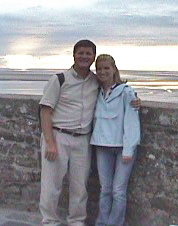
Mont San Michel - Summer 2002

At the supermarché, my daughter Jamie and I purchased drinks and Belín brand crackers. We packed it up and headed out to the low-lying pasture lands that defined the end of the mainland and the beginning of the tidal mudflats. We spent the afternoon basking in the sun, stretched out on our ponchos, sipping our drinks and munching on crackers. There were local folks fishing in the canal, occasionally catching a fish, but mostly whiling away their time while exercising the “art of doing nothing”.
Late in the day sheep began to appear, apparently heading home for the evening. Far in the distance, we could see a shepherd and his dog encouraging the herd in the direction of the gate located just beyond our position. Finally, all the “baahhhing” ended as we saw the man and his dog pass through the gate and head towards home.

Sunset and High Tides

As we passed through the gates that marked the beginning of the fortified Mont St. Michel for the second time this day, we were treated to a completely different sight than that of just six hours before. Now at 9 p.m. the island was desolate! Just a few lucky tourists fortunate enough to have stayed on the island for the night. Winding our way up the crooked street we saw the village closing after another busy day. Women were sweeping their shops, there were some people eating or drinking in the local bistro, but for the most part, the streets were left to us. 


We arrived near the abbey doors, found a quiet spot to enjoy the sunset and waited! As usual, the sunset was beautiful, a ruby red dollop of orange melting into the deep blue sea. 

After the sunset, some folks in my group found a stairway down to the mudflats on the west (oceanside) of the island. From my vantage point up at the abbey I could see the kids in the group playing soccer and walking out on the muddy flats left vacant by the receded tide. The kids’ moms and I sat enjoying the view and peace of the abbey. We noticed our daughters walking far out from Mont St. Michel toward the other island about two kilometers to the north. Of course, there was no danger because it was low tide and we could see others wandering on the mud flats too. But unbeknownst to us and our daughters out on the flats, the tide had begun to return for the second time of the day.
We stood helplessly, watching the tide come in and our daughters, apparently unconcerned, making their way back toward us. We could hear their laughter and playful screams in the distance as they passed through tidal pools getting wet and muddy. But, from out high vantage point, we could see  the tide rolling in swiftly. I was not too concerned because from our vantage point I could see that they were walking much faster than the incoming tide. The problem was that it was now almost dark, and the girls appeared only as shadows on the distant mudflats. 
Soon a helicopter began circling the Mont and then headed out to the girls on the mud flats. As we watched from the safety of the abbey walls we saw the helicopter swoop down and land near our daughters. This started our hearts racing, knowing there must be imminent danger for the helicopter to land and send a person out to get our kids. But to our amazement the would-be rescuer approached them, apparently said something and returned to the helicopter, then flew off toward the mainland. Our girls began heading away from the Mont toward another group of people on the flats. Once they merged with the other group we saw they were taking a route around some tidal pools and then back toward the Mont.
Finally, they were within a few hundred meters of Mont St. Michel. We could hear their voices and see them covered with dingy gray mud up to their knees. Up the stairs they came, sheepishly making excuses about their adventures. They told us the helicopter guy had come to tell them about the approaching tides and to warn them of pools of quicksand located in their path. He had advised them to join the larger group, which was under the supervision of a local guide. They had joined the group but the guide spoke only French and they could not understand why he was leading them away from the direction they needed to go.
By this time it was approaching midnight. We walked in silence down the Mont and out onto the causeway that connected it to the mainland. About halfway across we looked back. There, basking in the beauty of a full moon was Mont St. Michel adorned by the ancient abbey, its gothic spires reaching to heaven, a perfect example of man’s handiwork seeking to praise God! 


As the Christian pilgrims have done for centuries I too offered a prayer that night thanking God for protecting my kids’ “explorations” on the mudflats!


********************************************************************************

If you found this article informative, please share it with your friends, family, coworkers and associates. If you have something to add, just leave a comment in the box below.

Do you want to learn more about traveling to Europe? There is a wealth of information and special discount pricing on my tours at http://davidmcguffin.com/.

David McGuffin is Founder and CEO of David McGuffin’s Exploring Europe, Inc., based in Middleburg, Florida. You can connect with him on  Twitter,  Facebook,  Google+,  LinkedIn and YouTube. David spends his time in Europe organizing and leading small group and independent tours to European destinations. In business since 2001, David has provided exceptional travel opportunities to several thousand satisfied customers. You can find out more about David and his European tours at his website, http://davidmcguffin.com.

Monday, October 17, 2016

Packing Tips and Tricks

by David & Charlotte McGuffin, Dawnielle Jacobson, Audra Dupuis and Natalie Kelly

Packing can sometimes be the worst part of a trip: spending too much time deciding what to take and then regretting bringing too much. Here are some packing tips, travel “hacks” and a few suggested packing lists to help you pack quickly and efficiently and get on with enjoying your trip.

My number one tip

Jim and Roberta - My best-ever packers
Pack light! I usually travel with one carry-on suitcase (9x14x20) and a small backpack (This may seem impossible, but all you have to do is follow the tips in this blog). On my group tours, everyone has to lug their bag around, over uneven cobblestone streets and up several flights of stairs. Don’t make yourself miserable by bringing an oversized bag. As an added bonus, bringing a carry-on means you can be sure that your bag will show up at your final destination. If your checked bag doesn’t make it on the plane, it may take several days for your bag to catch up with you, especially if you are on tour. Be sure to check with your airline for carry-on size restrictions and measure the bag yourself (wheels included).

If you’re worried about having room for souvenirs, consider packing a duffle or other foldable bag in your suitcase to check on the way home.


What type of clothing to pack for Europe

Bring comfortable clothing. There is no need to buy a new travel wardrobe. Make sure you have comfortable walking shoes that are travel tested.

Pack items that can be layered for varied climate. Sweaters or a light jacket should suffice, except for winter travel. Jeans, pants and skirts are fine; Europeans don’t wear shorts unless they’re at the beach or out doing exercise.  In the summer, I pack one pair of shorts that can do double duty for jogging/exercise and swimming and one pair of very lightweight cargo shorts.  I also bring a pair of jeans and a pair of lightweight wool slacks which are unbelievable cool, dressy and comfortable.

Bring shirts and blouses that can be mixed-and-matched so you can make multiple outfits out of a few staple items. For an extended stay, you can also wash items in your bathroom sink or go to a laundromat if needed.

Most European churches require respectful dress; knees and shoulders must be covered. Make sure you plan ahead for those days or bring a scarf or shawl to cover your arms.

Making it fit

Pick out your clothes, shoes and accessories for the trip. Then put a third of it back. Most people are over-packers. Put back the shoes that look nice, but are not warm or comfy. Put back that “just in case” outfit. All makeup should fit in one little sandwich baggie. Pick your favorite makeup look and only pack the stuff for that.

Most hotels have a hair dryer, but they usually are less powerful than what we are accustomed to at home, so you might consider bring a small travel-sized blow dryer.  Do yourself a favor and go out and purchase an inexpensive dual voltage (120/240 VAC) blow dryer from Target or Walmart.  These usually sell for less than $20.  An added bonus is you'll not need to voltage converter to use it, just a wall socket adapter.

Plan to wear the bulkiest items on the plane.  Wear your biggest pair of shoes, your thickest scarf, maybe a sweater, and your coat.  You can remove these items as soon as you board, but doing this will free up space in your bag.

Roll your clothes. This is a big space saver. If you are really pressed for space, you can even put your clothes in gallon Ziploc bags and push the air out as you seal them. Consider filling bags by outfit so your luggage is well organized and you don’t have to search for things.

Fill your shoes (and bras) with socks and underwear to use every available space.

Don’t wait until the last minute to pack. Give yourself time to make sure it all fits and that your bag won’t be too heavy for you.

A few more packing hacks

  • Put dryer bounce sheets in between your clothes to keep them smelling fresh
  • Pack the heaviest items in the bottom of your suitcase (by the wheels) so that it is easy to roll
  • Use a contact case to store liquid makeup, like foundation
  • Keep powder makeup from breaking by putting a cotton ball or pad in the compact
  • Use a pill case to separate jewelry
  • Put your shoes in a shower cap or plactic grocery bag to contain any dirt
  • Roll up your belt and put it in the collar of a dress shirt to keep the collar stiff
  • Use an old glasses case to store your chargers and/or headphones so they don’t get tangled
  • To prevent liquids from spilling, unscrew the lid, cover with a small piece of plastic wrap and then screw the lid back on
  • Use a large binder clip to cover your razor
  • Store cotton swabs in an old medicine bottle


Winter travel tips

If you are traveling in the winter, make sure you are prepared for the “worst” weather. You will probably encounter snow and ice. The sun reflects off the snow, so don’t forget the sunscreen and sunglasses. Bring warm socks and shoes and clothing you can layer. Wear your heavy winter coat on the plane and stow it in the overhead bin. This will save a lot of space in your suitcase.

My wife and I use the following packing lists for winter travel:

Charlotte’s Winter Packing List
  • One Heavy Winter Coat – hip length or longer;
  • Gloves;
  • Earmuffs;
  • Several scarves for fashion and warmth;
  • At least one hat;
  • Small travel umbrella;
  • Boots/shoes that are comfortable, well broken-in, and travel-tested;
  • Thermal socks;
  • Five pairs of pants and/or jeans;
  • Long-sleeved fashion tee shirts;
  • Sweaters and Turtleneck shirts;
  • “Cuddle-duds” (long underwear) from JC Penney;
  • Underwear and bras for the trip’s duration.


David’s Winter Packing List
  • Hip-length wool pea coat;
  • Gloves;
  • Earmuffs;
  • Several scarves for fashion and warmth;
  • At least one hat;
  • Small travel umbrella;
  • One pair waterproof Gortex boots that are comfortable, well broken-in, and travel-tested;
  • three pairs of light-weight, moisture-wicking socks;
  • two pairs of pants and/or jeans;
  • Four moisture-wicking long-sleeved tee shirts;
  • Four long-sleeved cotton button-down shirts;
  • Two lightweight cashmere sweaters;
  • Underwear for the trip’s duration;
  • One pair of lightweight silk “long-johns.”


Packing List

Here are some additional packing suggestions, which can be adjusted based on the time of year.

The Essentials
  • Passport (valid at least 6 months beyond the end of your tour)
  • Debit/Credit cards (inform providers of your travel dates)
  • Insurance cards (just in case)
  • Driver’s license (as an extra ID)
  • Photocopies of the above (in case they are lost or stolen)
  • Medications (enough to last through the tour)
  • Travel insurance documents
  • Moneybelt (to keep your important documents safe)

Clothing
  • Underwear/Socks
  • Leggings/Tights
  • Shoes (well broken-in)
  • Pants/Skirts
  • Shirts
  • Sweaters
  • Light jacket
  • Pajamas
  • Scarf
  • Bathing suit

Winter Clothing
  • Thermal socks/Underwear
  • Boots
  • Heavy winter coat
  • Long-sleeved shirts
  • Gloves
  • Earmuffs/Hat
  • Scarves

For the Outdoors
  • Umbrella/Raincoat
  • Sunglasses/Hat
  • Chapstick/Sunscreen

Toiletries
  • Makeup/Hair products
  • Soap/Shampoo/Conditioner
  • Toothbrush/Toothpaste
  • Deodorant
  • Brush/Comb
  • Additional items (Cotton swabs, nail clippers, tweezers, razor, hair ties, bandages, dental floss, etc.)

Other Items to Consider
  • Earplugs/Eye cover
  • Glasses/Contacts/Contact solution
  • Headache/Stomach ache/Motion sickness medication
  • Alarm/Watch
  • Camera/Memory cards/Charger
  • Batteries (and charger)
  • Phone/Charger
  • Tablet/E-reader/Charger
  • MP3 player/Charger
  • Adapter/Converter
  • Travel journal/Pens
  • Snacks for the plane
  • Foldable duffle/Tote bag (if you plan to buy many souvenirs)


Summary

Heavy bags = lots of stress!
With this information, I hope you are ready to grab that suitcase and start packing. Remember to pack light, bring appropriate attire for the location and the weather, don’t bring too much and use your space efficiently. I hope you find my packing lists useful.


********************************************************************************
If you found this article informative, please share it with your friends, family, coworkers and associates. If you have something to add, just leave a comment in the box below.

Do you want to learn more about traveling to Europe? There is a wealth of information and special discount pricing on my tours at http://davidmcguffin.com/.

David McGuffin is Founder and CEO of David McGuffin’s Exploring Europe, Inc., based in Middleburg, Florida. You can connect with him on  Twitter,  Facebook,  Google+,  LinkedIn and YouTube. David spends his time in Europe organizing and leading small group and independent tours to European destinations. In business since 2001, David has provided exceptional travel opportunities to several thousand satisfied customers. You can find out more about David and his European tours at his website, http://davidmcguffin.com.

Monday, October 10, 2016

Hints on Tipping in Europe

In the United States, we’ve been raised on a tradition of tipping cabbies, hotel staff, bartenders, waiters and a variety of other service-oriented personnel.  Consequently, for Americans it seems normal to provide a tip or gratuity for good service.   When traveling in Europe tipping is not near as common as you might think and it certainly is not as lavish. While nothing about tipping is concrete, I hope these guidelines will relieve some stress and help you fit in like a local when traveling through Europe.

The information provided here is based on my extensive travels in Europe and my conversations with restaurant and hotel employees as well as local patrons. I’ve found a few generalities, which I’ll discuss first, and then I’ll dive into a country-by-country account.

Generalities

Europeans tend not to be as generous with their tips as we Americans.  In general, European restaurant servers are paid a salary and tips are considered a bonus on top of their wages. When pondering your tip, keep in mind a 5-10 percent tip is normal.  Only well-meaning or lavish-spending Americans leave a tip of 15-20 percent.  This is absolutely unnecessary and culturally inconsiderate.  Anywhere in Europe you’ll be safe by following the lead of Europeans and leaving a euro or two per person in your party.  In most cases the tip should be given directly to your server, not left on the table.  It is always a good idea to pay for your meal in cash as most Europeans do.  Paying with a credit card is common in some countries, but there is seldom an opportunity to add the tip to the final total.  If you are dining with a group, remember there is no such thing as “splitting the bill” whether it be with cash or credit card.  Please don’t be an arrogant American and try to push our customs on your server; it is rude.

If you take a taxi it is appropriate to round up the fare a euro or two as the cabbie’s tip.  Be prepared to pay the fare and tip in cash; there are no credit card machines in taxis.  

In hotels, it is appropriate to leave a hotel housekeeper one or two euros a day for their service and provide a euro or two for portage to your room.  It is not necessary to tip a doorman or anyone who hails a taxi.


Austria

It is customary give a 10%-15% tip at restaurants. Pay the tip in cash and hand it directly to the waiter when paying your bill.  There is a little trick to doing this in “Germanic” countries.  Let’s say the bill is €25 and you want to give a €5 tip.  Hand the waiter a €50 note and say, “30”.  The waiter will give you back 20 euros and keep 5 for himself.  You can walk away feeling like a local!

Croatia

Tipping is becoming popular in Croatia with the influx of mass tourism.  In a bar or sandwich shop, round up.  In restaurants with great service, leave 10%-15%.  Always give your tip to the waiter or waitress in the local currency.

If cruising on a private charter along the Croatia coast, plan to tip the captain and crew (collectively) about $50-$60 per person in your party.  If there is a cruise tour director, you should tip them about $12 a day per person.  This should be done in kunu (the local currency) or euros.

Czech Republic

Often a service charge is included in your bill.  If so, it will be clearly stated, usually in English.  Whether it is included or not you might consider giving an extra 5%-10% tip for good service.  Give your tip, in cash, directly to the waiter or waitress. 

France

Tipping in France is not common nor is it expected.  Those in the service industry are paid a salary and therefore do not count on tips as part of their income.  If service is exceptional, rounding up a euro or two is plenty. Restaurants and cafés typically include a service charge in the price of your meal. It usually is noted on the menu as service compris and will not be a line item on your bill.  Some tourist restaurants do not include this (in hopes of getting a bigger tip from Americans).  This is noted on the menu as service non compris and in this case a 15% tip is ok.

Germany

It is customary give a 10%-15% tip at restaurants. Pay the tip in cash and hand it directly to the waiter when paying your bill.  There is a little trick to doing this in “Germanic” countries.  Let’s say the bill is €25 and you want to give a €5 tip.  Hand the waiter a €50 note and say, “30”.  The waiter will give you back 20 euros and keep 5 for himself.  You can walk away feeling like a local!

Greece

The general rule of thumb here is the more expensive the restaurant, the lower the tip.  If you dine in an inexpensive taverna and spend €20 or less per person, then tip 10%.  Anything over €20 per person, tip 5%.  

Ireland

The “old Irish people” never tip.  Tipping was never their custom and theirs was a hard life growing up in the mid-20th century.  You’ll find them counting their pennies to the tee. The younger Irish, those under 40 years old, usually tip when ordering food but seldom when just having a drink.
Pubs - If you are simply served a drink by the guy/gal behind the bar then no tip is expected.  In the countryside, if it is not busy and the bartender “chats you up”, then leave a 15% tip with each drink or at the end of your drinking session. If the bartender is the proprietor, then no gratuity is expected, however it does not hurt to offer to buy him/her a drink.
Restaurants and Pubs that serve food – A 15% tip is standard for good table service. Up to 20% if exceptional service and extra “chatting up.”

Italy

Most often you will find a cover charge and service charge included in the price on the menu.  This will be noted, usually at the bottom of the menu, by il coperto and servizio incluso. The cover charge usually includes tap water and bread on the table.  The two usually add up to 15%-20%, but you’ll never see that published anywhere.  It is considered a generous gesture to round up your bill by a euro or two for exceptional service. Occasionally, you may find servizio non incluso (service not included) at tourist restaurants. In this case a 10% tip, handed to your waiter or left on the table, is fine.

The Netherlands

Value Added Tax (VAT) is included in every bill in the Netherlands.  It is not necessary to tip a taxi driver, hotel, restaurant or anyone in the service industry.

Spain

Service is always included at every bar or restaurant in Spain.  A tip is not necessary.  However, it is acceptable to leave 5%-8% for exceptional service.  Give your tip directly to the waiter or waitress in euro cash.  Do not leave it on the table.

Switzerland

A service charge is automatically calculated into your bill at restaurants.  For great service, you can round up or tip 5%, but it is not expected.  Always give your tip directly to the waiter in Swiss Franc cash.

United Kingdom (England, Scotland, Wales and Northern Ireland)

You do not need to tip in pubs when ordering drinks or food at the bar. In restaurants, often a service charge of 12.5% is added, so be sure to check your bill before paying. If no service charge is added, then a 10-15% tip will be appreciated, but it is not expected.  

Summary

When tipping in Europe it is important to keep in mind that the tip may already be included in the bill. You can always round up or leave a euro or two for each member of your party, like the Europeans do. A 5-10 percent tip is normal but anything more is excessive, since most servers receive a salary. Be sure to give the tip directly to the server in cash. It is also customary to tip cabbies and hotel staff a euro or two for their service.

********************************************************************************
If you found this article informative, please share it with your friends, family, coworkers and associates. If you have something to add, just leave a comment in the box below.

Do you want to learn more about traveling to Europe? There is a wealth of information and special discount pricing on my tours at http://davidmcguffin.com/.

David McGuffin is Founder and CEO of David McGuffin’s Exploring Europe, Inc., based in Middleburg, Florida. You can connect with him on  Twitter,  Facebook,  Google+,  LinkedIn and YouTube. David spends his time in Europe organizing and leading small group and independent tours to European destinations. In business since 2001, David has provided exceptional travel opportunities to several thousand satisfied customers. You can find out more about David and his European tours at his website, http://davidmcguffin.com.


Tuesday, September 13, 2016

Restaurant Survival Guide for Traveler

When traveling abroad, a good traveler expects to run into cultural differences. With a little planning, we can prepare for the big ones, like the language or local customs. But it is often the little things, the things we take for granted and couldn’t fathom doing differently, that really trip us up. So to help you prepare, here is a guide to the little quirks of dining abroad from ordering drinks to interacting with your waiter and everything you need to know about refills, ice, water and tipping.

Drinks


Refills

Free refills on sodas, coffee, tea or any other beverage is an American thing. In Europe, you purchase your beverages by the glass. In most places there are no fountain drinks, so if you order a soda, you’ll get a can. And hopefully it was refrigerated, which brings me to the next item…

Ice

Until recently, Europeans would look at you like you were crazy if you asked for ice with your drink, and then bring you one single cube. It’s not common, it’s not the custom and it’s only for outsiders. Many restaurants don’t have ice on hand for cooling drinks. Instead, they use it to chill the fish. And you do not want that ice in your drink! The best outcome you can hope for is that the little cubes will lower the drink’s temperature at least a few degrees before melting away. 

We Americans are obsessed with having ice-cold drinks. I recently saw someone put ice in a glass of wine and I gasped in horror. I thought to myself, “If the Europeans could see you defiling that wine, they would die!” Let’s face it, that extra-large soft drink from your local fast-food joint is just a cupful of ice with a little bit of soda. But the fact is, ninety percent of the world’s population make do without ice every day and don’t even know what they are missing. 

Water

A few years ago I was hiking in the Alps near Interlaken, Switzerland. I was doing a little exploring on my own and checking out some new destinations for my tours. I decided to take on a rather challenging day hike high up in the mountains. Early in the morning, I took a train up to my starting point and off I went through green meadows that seemed to cascade endlessly down the steep hills under a blue sky dotted with puffy white clouds. It was a perfect day for hiking! 

Three hours into the hike my water bottle was dry and I was looking for anything to rehydrate my aching body. I came across a little restaurant at one of the highest points on the trail and went in to buy a liter or two of water to get me through the next five hours of hiking. Well, all they had was water with gas! At the time I hated water with gas, but weighing the possibility of no water for the next five hours or water with gas, I purchased the water. That’s the day I learned to like the stuff.

Europeans have been purchasing their water for as long as I can remember. Originally this stemmed from the idea that tap water was unsanitary or that the natural minerals which bottled “spring water” contained were good for you. Whatever the reason, whether at a grocery store or in a restaurant, it is customary to purchase “bottled mineral water” when dining out. It is even customary to purchase water at the grocery for consumption at home.

Bottled water comes in two varieties: with and without gas. The gas is simply carbonation, CO2, the same stuff that makes a cola fizzy. But drinking it and enjoying it requires an acquired taste (It’s a lot like when you get a fountain drink and the syrup is running low). In North America, two popular brands of “water with gas,” or sparkling water, are Perrier (from France) and San Pellegrino (from Italy). Nowadays, you can find these at most grocery stores and finer-dining establishments in the US.

When traveling throughout most of Europe, you should plan on paying for a bottle of water with your meal. Doing so will ensure you get fresh and clean water that is reasonably chilled. It will come with glasses but no ice. Two varieties are readily available: with gas, and without gas. It’s not a problem to request either and most often the waiter will ask which you prefer.

How to request water:

ITALIAN - acqua natuarale senza gas (no gas); acqua con gas / acqua frizzante / acqua gazzata (with gas)
GERMAN - wasser no gas (no gas); wasser mit gas (with gas)
SPANISH - agua sin gas (no gas); agua con gas (with gas)
FRENCH - de l’eau plate (no gas); de l’eau gazeuse (with gas) 
Good news! In France it is customary to order a pitcher of fresh tap water at no charge. Simply ask for it! In French, it goes something like this: un carafe d’eau s’il vous plaît.

Interacting with your Waiter


Rule #1: Be kind to your waiter. 

This one may seem obvious, but the pressure of interacting with a language barrier tends to make people forget their manners. No one expects tourists to be fluent in a language before they travel, but learning the basics will go a long way. I can’t tell you how many times a simple “buongiorno” has prompted Italians to shower me with compliments on my “beautiful Italian.” At the very least, learn how to say hello, please and thank you and you will find a lot of friendly people willing to help you struggle through the rest of the conversation.   

Rule #2: Be aware of local dining customs. 

We Americans are always in a rush. So much so that we eat a lot of our meals on the go. In Europe, eating is a social event. And a 30-minute lunch is unheard of. Don’t expect your waiter to come by every five minutes to see if you are done. In Europe, this would be considered extremely rude. If you want something, chances are you’ll have to flag your waiter down. He isn’t being lazy or bad at his job; he’s giving you privacy to enjoy your meal in peace. This is great if you want to spend three hours catching up with your friends but can be frustrating when you are pressed for time. 

If you don’t have much time to eat, consider ordering from the “take away” counter. In fact, many restaurants and cafes near busy tourist sites offer the same menu to go. Just pick up your lunch and take it to a nearby park. This is a great option when the weather is nice. Don’t forget to grab a few napkins!


Rule #3: Reward your waiter for good service. 

Tipping rules vary from country to country, so you’ll want to do some research before you travel. Unlike in the United States, in many countries waiters must be paid at least the minimum wage. In those countries, a tip is appreciated but not expected and an excessively large tip can even be seen as an insult. 


Here are a few guidelines for tipping.


In France and Italy, a service charge is usually already included in the bill. If you stop for drinks, it is customary to leave the change, especially if the service was good. For example, if your bill is 3.50, you can leave .50 on the change tray. However, this is not required. If you are paying with a credit card, there probably won’t be a line on the receipt to leave a tip, so just leave some change on the table. For dinner, a tip of 5-10% is sufficient for all but the fanciest restaurants.

In the UK and Ireland, a service charge may be included in your bill. In the UK, the standard is 12.5%. If you can’t tell if it has been included, don’t be embarrassed to ask the waiter. In Ireland, this policy should be clearly listed on the menu. You can still leave an additional tip for particularly good service. If there is no service charge, plan to leave between 10 and 15%. In the pub, people generally do not leave a tip. But here again, if the service was exceptional, the bartender filled several orders or was very friendly, you can leave a small tip.  

Summary


Dining abroad doesn’t have to be stressful if you’re aware of a few key differences. There are no free refills on drinks, soda usually comes in a can, there is no ice for drinks and you have to purchase water. Remember to specify whether you want still or sparkling water. Being friendly to your waiter will make for an enjoyable experience. Try to learn a few words in the language, because this gesture is very much appreciated in non-English-speaking countries. Understand the local customs. Your waiter isn’t ignoring you, he’s giving you privacy to enjoy your meal without interruption. And finally, know the local tipping customs so that you can reward him for good service. With this in mind, you should be all set. Bon appétit!

********************************************************************************
If you found this article informative, please share it with your friends, family, coworkers and associates. If you have something to add, just leave a comment in the box below.

Do you want to learn more about traveling to Europe? There is a wealth of information and special discount pricing on my tours at http://davidmcguffin.com/.

David McGuffin is Founder and CEO of David McGuffin’s Exploring Europe, Inc., based in Middleburg, Florida. You can connect with him on  Twitter,  Facebook,  Google+,  LinkedIn and YouTube. David spends his time in Europe organizing and leading small group and independent tours to European destinations. In business since 2001, David has provided exceptional travel opportunities to several thousand satisfied customers. You can find out more about David and his European tours at his website, http://davidmcguffin.com.


Dynamic Currency Conversion… Just Say No!


Have you ever been asked “Would you like that in dollars or euros?”  Or perhaps a “yes” or “no” box pops up on the point of sale machine asking if you would like to choose your home currency.  This is called Dynamic Currency Conversion or DCC and it is becoming the norm in many countries worldwide.  At first, it sounds like a good idea, but for the consumer it is very expensive and should be avoided at all costs!

On the other hand, it is very good for the merchant because they make a huge commission for offering this service.  In most cases the cardholder will be hit with a 7% markup above the current bank exchange rate. Take a look at this UK MasterCard website promoting DCC for its merchants.  Here you can clearly see that DCC benefits the merchant, and MasterCard makes up some lame reasons as to how it benefits customers.

photo credit: http://howtogeek.com
Often the choice of accepting DCC is presented in a matter-of-fact manner, giving no indication that it is a bad (or good) idea.  But don’t blame the cashier, unless they are the owner of the shop, they are probably required to offer the pitch in a certain manner and tone of voice, such as, “Would you like that in dollars or sterling?”  This, coupled with a stately British accent is bound to sway some travelers to accept the idea.  However, it is never a good idea to convert your transaction with DCC into your home currency.

With today’s regulations, merchants are required to notify the cardholder that DCC is available and there is a choice.  Originally, the merchant was not required to notify the cardholder that DCC was being applied.  The customers would simply make the purchase, get a sales receipt in the local currency and the DCC would be applied afterward in the “back office.”  The cardholder would not know this had occurred until they received their credit card statement. Initiated by Visa and MasterCard, this practice is now forbidden and all credit card companies impose penalties on merchants who fail to comply.

In order to get around the back-office DCC regulation, merchants will sometimes automatically select DCC without the cardholder having a chance to accept or deny.  The conversion will show on the sales slip and an unsuspecting customer may walk out the door none the wiser.  If questioned by the cardholder, the cashier may claim their point of sale (POS) machine automatically converts to the card’s home currency.  This too is incorrect and if detected, the cardholder should immediately request that the sale be reversed or voided and run again in the local currency.  However, this could be difficult, especially if working against a language barrier.

Tips to help you make the best of your travel dollar

- Notify your bank and credit card company when you will be traveling outside your normal spending area.  This is important when traveling at home or abroad. Most banks will put a travel exception on the account so that your spending will be approved while traveling.  If you do not notify your bank or credit card company, you will be denied access to your funds.

- Always refuse DCC, no matter how tempting the comfort of working in your home currency. Following this simple rule will cut at least 5-7% off your purchase before ever leaving the checkout counter.  DCC in not ever required so don’t feel obligated to accept it, even if the merchant selects DCC without your knowledge. If this happens, the cardholder should immediately request that the sale be reversed or voided and run again in the local currency.  

- Use a credit card that has no foreign transaction fees.  Most credit cards issued in the USA charge fees up to 3% for transactions originating outside the USA.  This applies to both point of sales and online transactions.  So, it only makes sense to find a credit card that carries no fees for foreign transactions. I’ve found that many American Express cards have no foreign transaction fees.  I use the Barclay Arrival Plus World Elite MasterCard which offers no foreign transaction fees, true Chip and Pin capabilities, and lots of benefits in the form of travel rewards.

- Don’t use non-bank ATM’s.  You’ll often find these stand-alone machines in small convenience stores, at gas stations and roadside auto stops. These machines are owned and controlled by the local merchant, not a bank.  The owners of these ATM’s are free to mask the DCC options any way they like, and you can bet it will be to their liking, not yours.  Steer clear of these machines, but if you must use them, be sure to read all the screens carefully and opt out of DCC.  Sometimes you will see messages such as “lock-in your rate” or “guarantee your conversion”. Others may post messages such as “press yes for dollars”.  Double check everything and always opt out of anything that looks like DCC.  Alternatively, you can always cancel the entire transaction before you enter your final “yes.”

- Always check your printed receipt.  Somewhere at the bottom you’ll find the cost in the local currency.  If USD is mentioned anywhere on the receipt, then you’ve been had by the DCC con game.

- Download a currency converter app to get up-to-the-minute exchange rates.  I like an app put out by OANDA.  It is available for Apple and Android.  Look for the name “Currency.”

Summary

Dynamic Currency Conversion (DCC) is a service offered to credit cardholders that offers to convert a foreign transaction at the point of sale into the home currency of the cardholder.  This is never a good idea for the consumer because it comes with inflated exchange rates that benefit the merchant.  An unsuspecting cardholder can lose up to 7% by opting in to this feature. Since DCC works against the purchaser, never say you would like your purchases to be converted to dollars.

*******************************************************************************

If you found this article informative, please share it with your friends, family, coworkers and associates. If you have something to add, just leave a comment in the box below.

Do you want to learn more about traveling to Europe? There is a wealth of information and special discount pricing on my tours at http://davidmcguffin.com/.

David McGuffin is Founder and CEO of David McGuffin’s Exploring Europe, Inc., based in Middleburg, Florida. You can connect with him on  Twitter,  Facebook,  Google+,  LinkedIn and YouTube. David spends his time in Europe organizing and leading small group and independent tours to European destinations. In business since 2001, David has provided exceptional travel opportunities to several thousand satisfied customers. You can find out more about David and his European tours at his website, http://davidmcguffin.com.

Search This Blog